For large Indian enterprises participating in government procurement, tender participation has evolved into one of the most operationally complex and risk-sensitive business functions — and artificial intelligence is beginning to change how the smartest organisations manage it.
Across sectors such as infrastructure, EPC, defence, railways, energy, healthcare and large-scale outsourcing, modern government tenders now involve massive multi-volume RFP documents containing thousands of technical, legal, commercial and compliance conditions that must be analysed with precision under extremely tight timelines. What was once a documentation exercise has increasingly become a high-stakes enterprise risk management process.
The Scale of the Problem
Large enterprises today routinely deal with tender documents running into hundreds — and in many cases thousands — of pages spread across technical specifications, contractual terms, financial criteria, scope definitions, statutory compliance requirements, deviation clauses, SLA obligations, penalty structures, eligibility matrices and corrigendums issued throughout the bid cycle.
The complexity compounds when multiple departments — legal, finance, operations, technical, procurement and business — must collaborate simultaneously to assess bid viability and prepare detailed technical submissions, often across several concurrent tenders.
The consequences of getting it wrong are significant. A misread liquidated damages clause, an overlooked subcontracting restriction or an incorrectly interpreted experience criterion can create serious commercial exposure — or disqualify a bidder outright before evaluation even begins.
Traditional tender preparation processes, built for a time when a tender might run to fifty pages, are increasingly difficult to scale across documents ten or twenty times that length. Multiple teams manually reviewing lengthy RFPs, maintaining fragmented compliance trackers, coordinating documentation across departments and preparing repetitive technical responses under severe deadline pressure — this not only increases operational overhead but also creates risks related to missed conditions, inconsistent interpretations and delayed decision-making.
Where AI Is Being Applied
Artificial intelligence is beginning to find practical application across several distinct stages of the tender lifecycle.
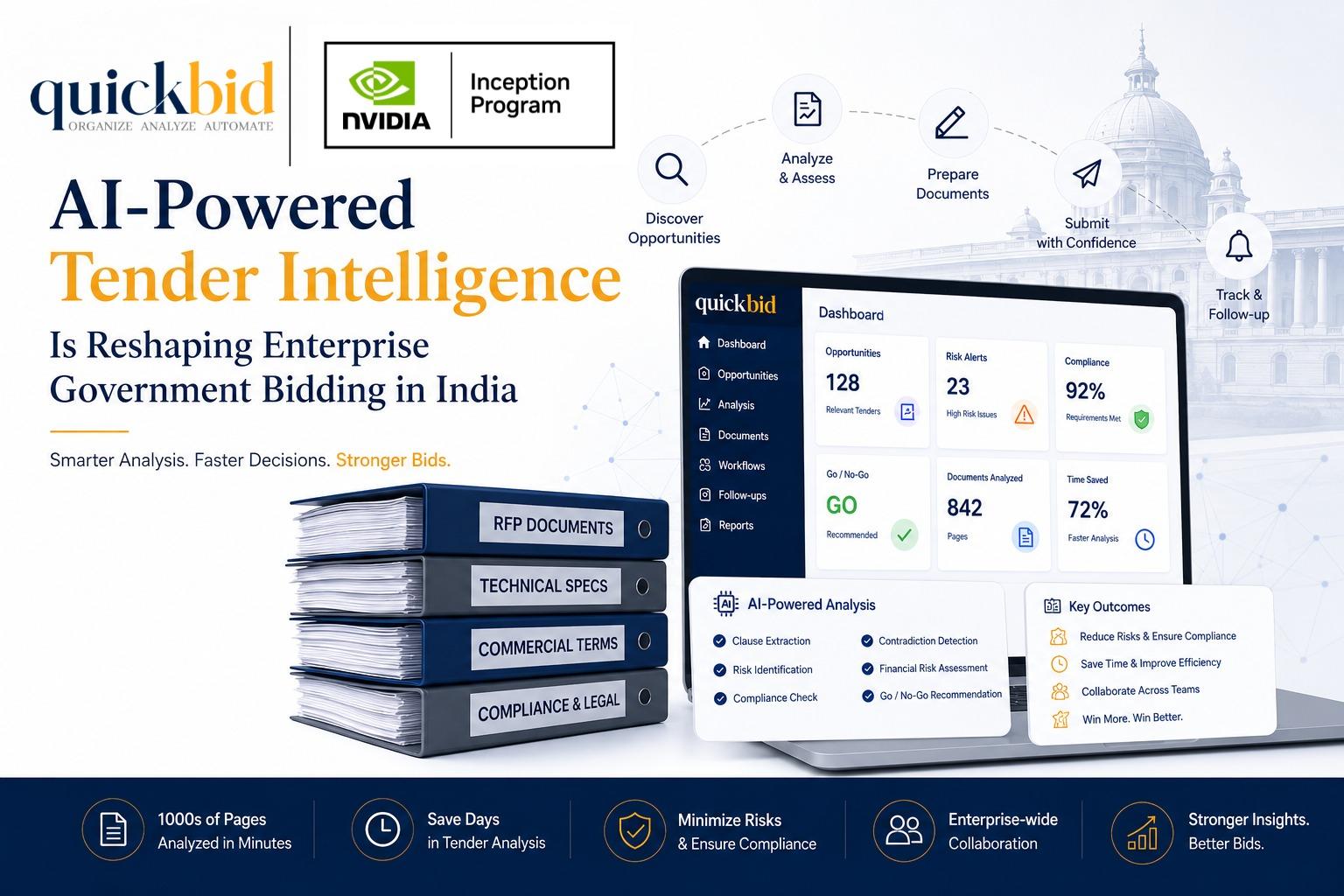
At the discovery stage, AI systems now continuously scan procurement portals — GeM, CPPP and state-level e-procurement platforms — and surface relevant opportunities based on configurable keywords, sectors, ministries and geographies, replacing the manual portal-checking that many bid teams still do daily.
At the analysis stage, AI can process complete RFP documents and extract what matters: eligibility thresholds, compliance conditions, contradictory clauses, financial risk exposure and Go/No-Go assessments. For a document running to several hundred pages, the difference between AI-assisted and manual review can be measured in days.
At the preparation stage, tools are now emerging that automatically extract annexures and schedules from scanned or image-based RFPs — a task that previously consumed significant hours — and auto-fill bidder data, generating submission-ready documents in a fraction of the time.
Beyond bid submission, AI is also being applied to post-submission tracking: monitoring evaluation results, flagging corrigendums and managing EMD and PBG recovery — areas where enterprises frequently lose money simply through poor follow-up.
Rather than replacing enterprise tender teams, these technologies are being adopted to improve analytical speed, operational visibility, workflow coordination and decision-making accuracy across the full bid lifecycle.
Limitations Worth Acknowledging
AI adoption in tender management is still early, and the limitations are real. Government procurement documents in India span multiple languages, vary significantly in formatting across states and agencies, and frequently contain domain-specific technical language that general-purpose models handle inconsistently.
More fundamentally, the highest-value decisions in tender participation — whether to bid at all, how to price competitively, which deviations are commercially acceptable — remain firmly in human hands. AI tools in this space are productivity aids, not decision-makers.
Independent validation of efficiency claims also remains limited. Most published figures come from vendors rather than third-party audits, making objective assessment of real-world impact difficult at this stage.
The Competitive Pressure Behind Adoption
What is driving enterprise interest, regardless of these limitations, is competitive pressure. As more bidders participate in government procurement and evaluation criteria become more rigorous, the margin for error in bid preparation narrows. Enterprises that can analyse a large RFP faster, coordinate cross-functional documentation more tightly and identify disqualifying conditions earlier gain a measurable advantage in both bid quality and submission speed.
"The enterprise government tendering environment has become extraordinarily document-intensive. Today, the challenge is not just preparing a bid — it is analysing vast amounts of information, identifying hidden risks, interpreting technical conditions correctly and coordinating enterprise-wide documentation workflows within strict submission timelines," said Anuj Kacker, Founder & CEO of QuickBid.
The technology underpinning these workflows is equally critical. "Building AI for government tendering requires more than language models — it requires understanding the structural complexity of Indian procurement documents, the security demands of enterprise data, and the need for systems that scale reliably across high-volume bid environments," said Vikas Kumar Verma, Co-Founder & CTO of QuickBid.
Among the platforms emerging in this space, QuickBid covers the full tender lifecycle — from discovery and RFP intelligence through to bid generation, post-submission tracking and EMD management. The platform uses a pay-per-use credit model rather than fixed subscriptions, allowing organisations to scale AI usage in line with their actual tendering activity — a practical consideration for enterprises managing variable bid volumes across financial quarters.
As public procurement ecosystems continue to digitise and competitive intensity increases, enterprise adoption of AI-assisted tender workflow systems is likely to accelerate. In the coming years, the competitive advantage in government tender participation may not be determined solely by organisational scale, but by how intelligently enterprises can analyse risk, process information and execute complex bid workflows in real time.
About QuickBid
QuickBid is an AI-powered government tender workflow management platform built for enterprises and MSMEs participating in complex public procurement and government bidding processes across India. The platform covers the full tender lifecycle — from intelligent tender RFP analysis, compliance workflow management and AI-assisted bid preparation, to post-submission tracking and EMD/PBG management. QuickBid operates on a flexible pay-per-use model, enabling organisations to access enterprise-grade tender intelligence without fixed subscription commitments.
Website: https://quickbid.co.in